Abstract
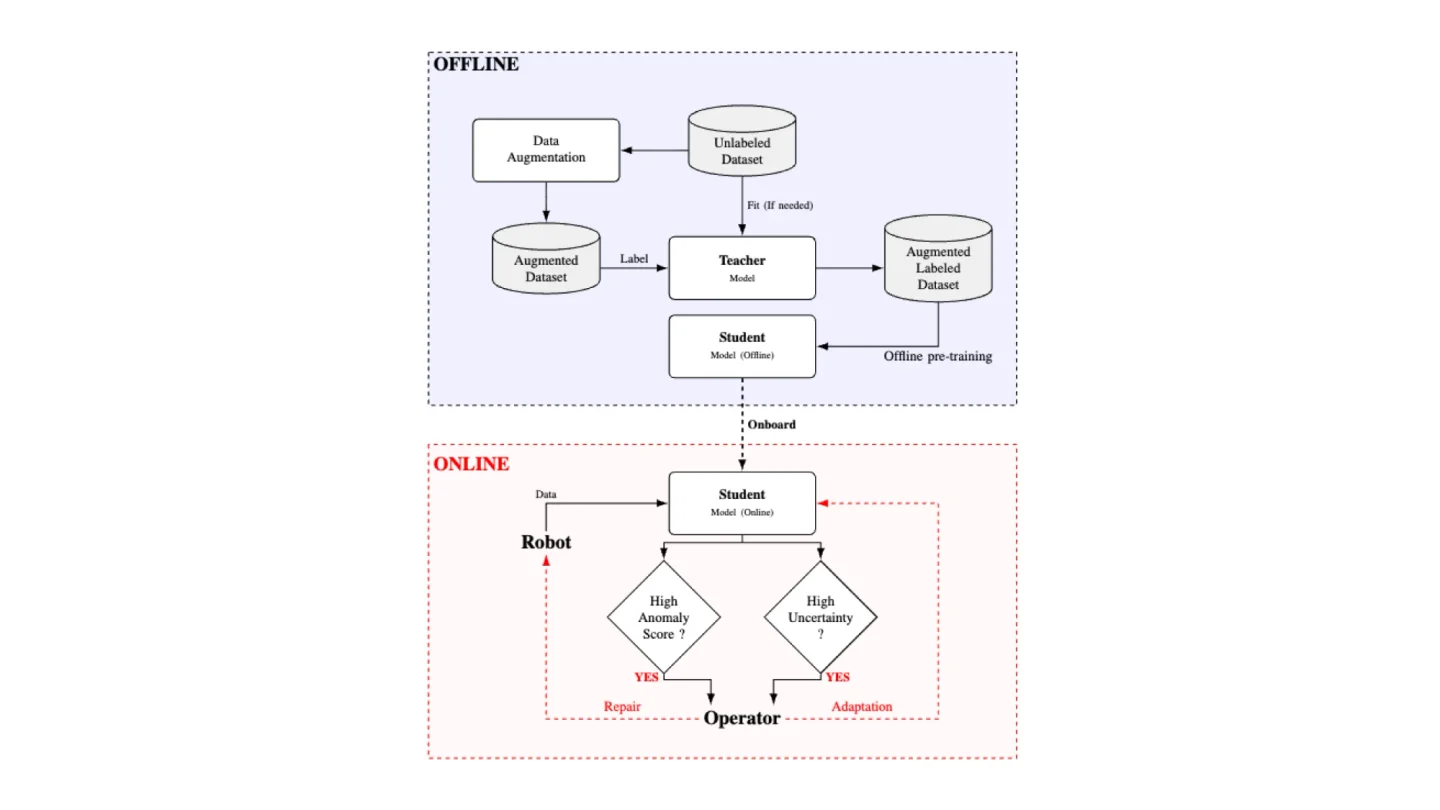
Mobile robots require robust, real-time fault detection capable of continuous adaptation on constrained edge hardware. While deep time-series models excel at unsupervised anomaly detection, their computational cost prohibits high-frequency onboard execution. This paper bridges this gap via a Teacher-Student distillation framework. An offline foundation model (TSPulse) generates pseudo-labels from unlabeled time series augmented with fault injections. A lightweight MiniRocket Student, adapted with a Recursive Least Squares estimator, approximates this complex decision boundary to execute real-time inference onboard. Evaluations on the TSB-AD benchmark and a physical mobile robot demonstrate the Student achieves a 4.30 ms CPU inference latency. During real-world domain shifts, online adaptation enables the Student to recover from unseen mechanical degradation, improving VUS-PR scores from 0.26 to 0.75 without catastrophic forgetting. Crucially, an uncertainty-guided active learning strategy minimizes operator cognitive load, requesting sparse interventions only when encountering novel fault distributions. These results validate the deployment of state-of-the-art anomaly detection on resource-constrained robotics through offline-to-online distillation.